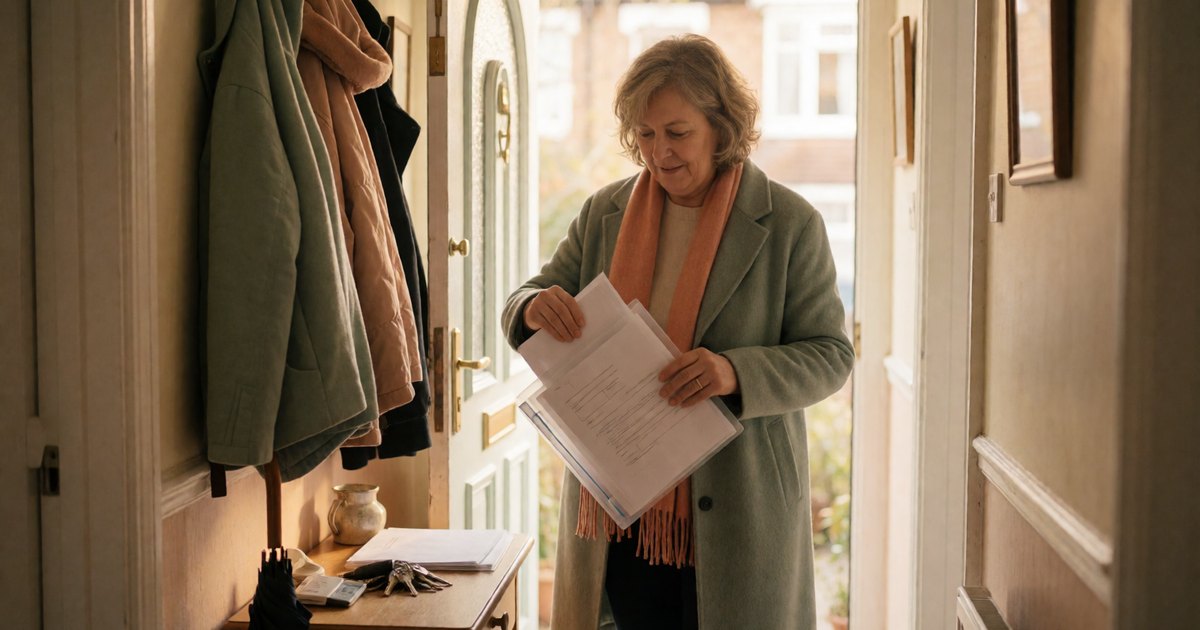
Start at the front door and work backwards. Decide the moment you need to leave, then ask three things: what needs to be in my hand, how am I getting there, and what do I want to ask? Then pick one small job and do it today.
Most of us prepare for appointments from the wrong end. We think about the appointment itself, feel a vague dread, and leave everything until the morning. Then the morning arrives and there is a missing letter, a bus we hadn't checked and a question we knew we had but can't find. The fix is not more willpower. It is starting from the door instead.
An imagined Thursday
Here is a made-up example, so you can see the shape. Say you have an appointment across town at 10:30 on Thursday. It could be anything: a dentist, a bank, a council office, a solicitor. What matters is that it is somewhere you have to arrive on time, with the right things.
Now work backwards, one step at a time.
10:30, the appointment. You want to be there a few minutes early, not sprinting in. So aim to arrive at 10:20.
The journey. Say it is a 35 minute trip, plus a ten minute walk at the far end. That puts you leaving the house at 9:35. Add a little slack for the things that always eat time, like finding your keys, and call it 9:25. That is your real deadline. 10:30 is not.
Before you leave. Shoes on, bag by the door, phone charged, and the documents in the bag. Those are the four things that make 9:25 possible, and none of them needs doing at 9:24.
Written out, your Thursday has a shape: out the door at 9:25, everything by the bag from about 9:00, and a few things settled beforehand so the morning has almost nothing to decide. The dread tends to shrink once the day has edges like this.
What should I prepare before an appointment?
1. Documents. Write down what you have to take. Letter, appointment confirmation, ID, a form you were asked to fill in, a card for payment. Check the invitation itself, because it usually says. Then put every one of those things in a single place, ideally the bag you will carry. A pile on the kitchen table is a pile you will rearrange on Thursday morning.
2. Travel. Look up the journey once and write down the answer. Which bus or train, which stop, how long the walk is at the end, and what you will do if the first option falls through. Do this the day before if you can, when nothing is hurrying you. If you are driving, add where you will park and how long it takes to find a space. You are not trying to plan every minute. You are trying to make sure Thursday-you is not doing research at a bus stop.
3. One question to ask. Appointments go by fast, and the thing you meant to raise is usually the first thing to vanish. So pick one question and write it where you will see it, on a note in your pocket or at the top of the letter. One is enough. If more come to you, fine, but you have already got the one that matters. Put it in your own words. It does not need to sound clever.
4. A smaller preparation task. This is the part people skip. Some jobs sound like one thing and are really five: "sort out my paperwork" is a good example. Shrink it until it is a job with an obvious first move. Not "get documents together" but "find the appointment letter". Not "plan the journey" but "check the first bus time". A small task has an end you can see, and you can finish it in the gap before a meeting or while the kettle boils.
What should I do today to get ready?
Do not do the whole list today. Do one thing from it. Pick whichever is the most annoying to leave, because that is the one that will cause a rush later. For most people that means one of these:
- Find the appointment letter or confirmation and put it in your bag.
- Work out your leaving time by counting back from the appointment, and write it down.
- Check the journey once, and note the stop or the parking.
- Write your one question on something you will carry.
Then stop. It is a small job, and finishing it is the point. Tomorrow you can do another, and by Thursday most of the morning has been dealt with in advance.
If your head is full of other things and you cannot tell where an appointment sits among them, it can help to empty it first. Our guide on going From brain dump to one workable next step shows how to get the crowded thoughts out and choose a single small action. Actual Day has a Brain dump for exactly that, and a Break it down tool in Plus for the jobs that look big. You review what it suggests and change whatever does not fit, so the plan stays yours.
If you would like to see how the different parts of the app fit into an ordinary day, from the morning check-in through to closing the day, A day with Actual Day: from morning check-in to shutdown walks through it. Actual Day is a capacity-aware planner for adults, including neurodivergent adults, who want help with everyday life as well as work, and appointments are very much part of everyday life. You can look around at Actual Day and decide whether it suits you.
One last thing. If you are not feeling up to any of this today, that is allowed. Choose the smallest possible version, such as finding the letter, and leave the rest. Working backwards is meant to take pressure off Thursday, not to add a new pile of expectations to today.
So, the short version. Start at the door. Count back to a leaving time. Gather the documents in one place. Look up the journey once. Write down one question. And do one small thing before you go to bed tonight.